Showing posts with label africa. Show all posts

12 October 2014

Reporting on Ebola, safely


Doctors, nurses, family and friends are taking considerable risks to treat people infected by Ebola. As Professor Peter Piot, the head of the UN's Ebola response, said: "the smallest mistake can be fatal".
Reporting a health crisis is possibly equally dangerous, but very different from reporting on a conflict or war zone. How do reporters and their crews cope?

A unique BBC report takes us behind the scenes, to look at the precautions that one team is taking to interview professionals and families and attend funerals. Notably, despite the breathing masks, full body suits and rubber gloves, the BBC crew are still not going into the 'Red Zone' where patients with confirmed Ebola infections are present. Sadly, it is often the poorly-equipped local staff, with limited training and poor compensation, who are doing the riskiest work in this crisis.

See the story and video here: http://www.bbc.com/news/health-29581414
For a grim read about the realities of an Ebola clinic, read this report in the New York Times: A  Hospital From Hell, in a City Swamped by Ebola 

06 September 2014

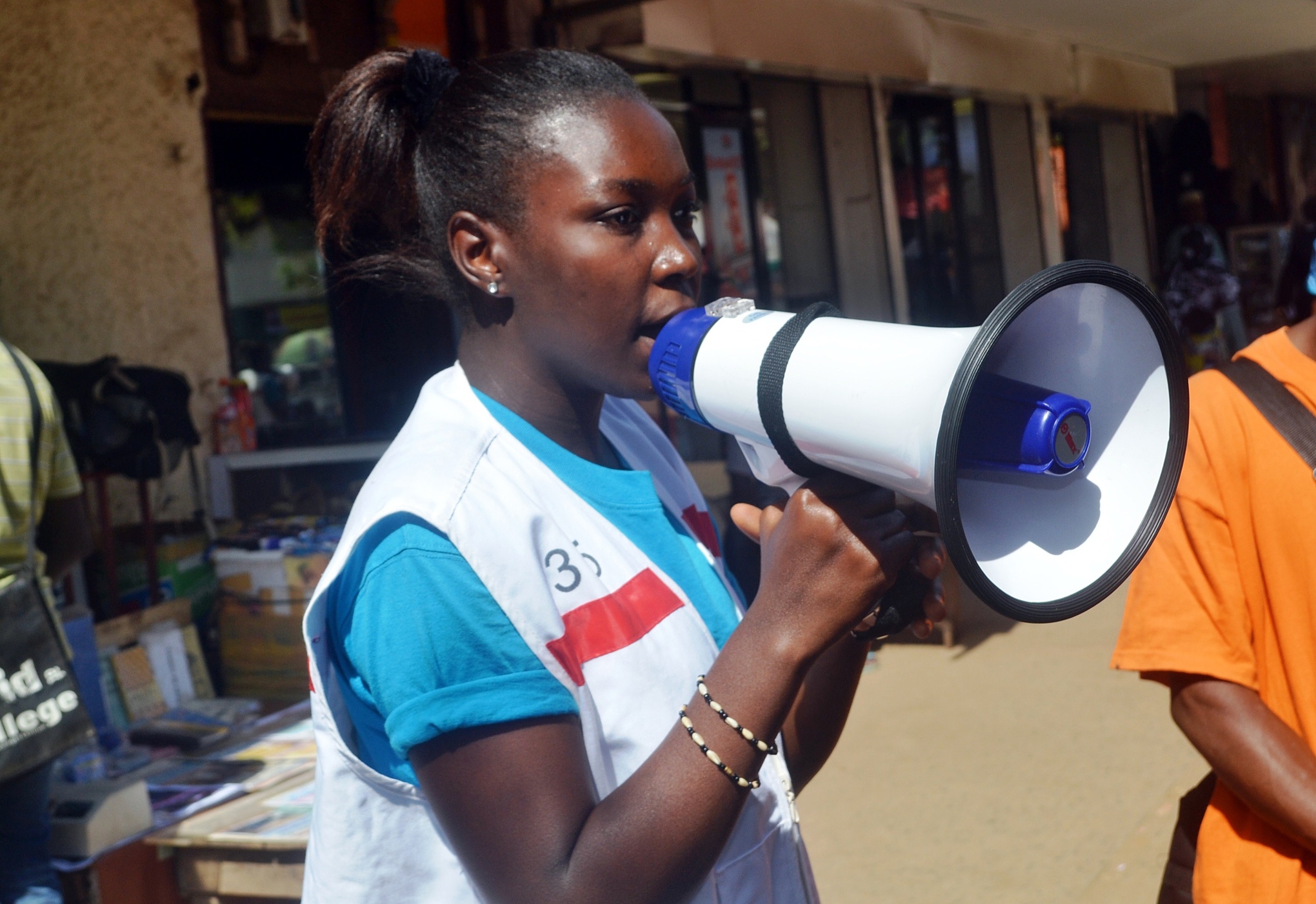
Ebola shows how (not) to communicate in a health crisis


IFRC - the International Federation of Red Cross and Red Crescent Societies - has spoken plainly about communication problems during the Ebola outbreak in Eastern Africa.

Ebola is scary because there is currently no proven cure. This has led to panic and strict controls, including border closures. That has limited the options for agencies, like IFRC, that are trying to help solve the crisis and treat the victims.

Though this story is full of development sector jargon, the message is clear: get people involved at all levels and don't just issue commands, but also listen and get local people involved.

"the communication approach in these circumstances should be “less top-down and less giving orders,” and not just limited to the agencies and their volunteers on the ground. It should be a multi-stakeholder effort, involving the corporate sector, the media and community leaders, with the government in a lead role. [Everyone] has a role to play here."

Read more on Devex.com

25 July 2012

Training for rock stars


Want to be trained by ACDC?
No, not the Australian rock band, but the African Centre for Development Communication.
ACDC provides a range of communications training courses for non-profit executive managers of communication functions and others. The aim is to hone managerial and communication skills and learn new strategies for using communications more effectively. Networking with local and international Communicators is a bonus. "Participants not only become stronger strategic communicators, they also learn to build the capacity of their organizations to use communications to reach their social change goals."
Course participants and trainers explore communications building blocks including planning and tactics, evaluation and fundraising. Of course social media is covered, as well as evergreen topics such as presentation delivery, media interviews and storytelling.
ACDC recommends the course for communication and PR managers and others responsible for strategic communication in non-profit organizations including governments, civil society organizations,training and research institutions, faith-based organizations and donor organizations. 
Courses are held in Nairobi, Kenya. Learn more here: http://goo.gl/yyQPBo

14 May 2012

Africans launch digital news contest


The first competition for digital news innovation in Africa has just been launched and closes in July. Winners will be announced on 10 November 2012.

Winners get cash prizes of up to $100,000 plus business, technical and marketing support. Finalists will be invited to a camp in Tanzania in August for workshops with mentors and industry experts.

Proposals can be submitted by news pioneers anywhere in the world, though they must have an African media partner to help develop and test the innovation.

This innovation challenge focuses on journalism and the news media. The organizers are looking for disruptive digital ideas for improving the way that news is collected and disseminated. This includes tools or strategies that use the Internet, mobile platforms, data driven journalism, computer assisted reporting, digitally augmented reality, or other electronic means to improve the relevance and impact of news media. 

Winning ideas should be focused on providing pragmatic solutions to real challenges facing African media.

Innovations are being sought in four broad categories: news gathering; story telling; audience engagement; or the business of news. Within these categories, the judges will look for ideas with the following goals:
  1. Strengthen existing media platforms, or harness new digital platforms for engaging audiences and transmitting news other journalistic content.
  2. Improve the way news reaches audiences, from traditional circulation / airtime management to newer disruptive ‘cross platform’ channels.
  3. Amplify the relevance and usefulness of news by improving the immediacy, depth and accuracy of journalistic content.
  4. Enhance the impact and ‘shelf life’ of news by extending its influence and intrinsic value for both audiences and content services.
  5. Deepen media’s understanding of its audiences and markets by improving user analytics, audience profiling and market segmentation.
  6. Boost the media’s resource base by diversifying business models, developing new revenue streams or improving operational efficiencies.

Finalists will be invited to the OpenNews Camp in Zanzibar, Tanzania, in August for one-on-one workshop sessions with business development mentors and other industry experts. Finalists will use these sessions to refine and strengthen their proposals, as well as develop implementation plans and budgets ahead of final judging.

Winners will receive cash grants of between $12,000 and $100,000, plus additional business development support, technical mentorship, and marketing support. Winners may also be offered opportunities to pilot their projects in AMI member newsrooms and showcase the results at international conferences or to venture capital funds.

All entries have to be made on the competition website: http://africannewschallenge.org

The African News Innovation Challenge (ANIC), is a pan-African contest designed to support digital innovation and experimentation that improves the quality and impact of African journalism. It that aims to accelerate innovation in news organisations by funding transformational ideas and then continuing to support them through a network of peers and advisors. It encourages new digital tools and techniques for ‘making’ news, new ways for audiences to engage with news, and new models for media organisations to sustain themselves. The idea is that the contest will support new media experiments and digital news startups in data driven journalism and investigative reporting, newsroom management, audience engagement, digital convergence and media business models.
ANIC is modelled on the Knight News Challenge in the USA, customised to address the challenges facing African media.

ANIC is run by The African Media Initiative (AMI), the industry association that is Africa’s largest umbrella body of media owners and executives.  AMI’s mandate is to serve as a catalyst for strengthening African media by building the tools, knowledge, and technical capacity for the media to play an effective  ‘public interest’ role in African society. This includes assisting with the development of professional standards, financial sustainability, technological adaptability, and civic engagement.  AMI believes that democracy thrives when people and communities are informed and engaged.  

ANIC funds news experiments and digital media startups in order to help cover the costs of developing, testing and scaling a new digital news venture or product.

Good luck!

09 June 2009

AudienceScapes project wins Gates Foundation support

The innovative AudienceScapes project by Washington-based InterMedia, has won support from the Bill and Melinda Gates Foundation.
A $1.3m grant will fund research in Africa of how people gather, share and shape news and information, particularly as it relates to development, and boost the AudienceScapes website, with 'Country Communication Profiles', an interactive global media and communication data map, etc.
The site is still in development, but shows promise, especially for students of media and those in development needing to know how to reach and engage with audiences.
How many radio listeners in Lagos? What's TV penetration like in Bosnia? How many use mobile phones in China? Is the media free and democratic in Peru?
"There is a great need for evidence-based research that supports and informs development communications," said InterMedia President Dr. Mark Rhodes. "It's an important base, a launching pad for an expanded research program and information resource for development organizations, starting in Africa but in other regions as well."
http://onhold.audiencescapes.org/

Translate